
Three Novels That Explain Modern France
On Books, Belonging, and the France I Am Moving Toward

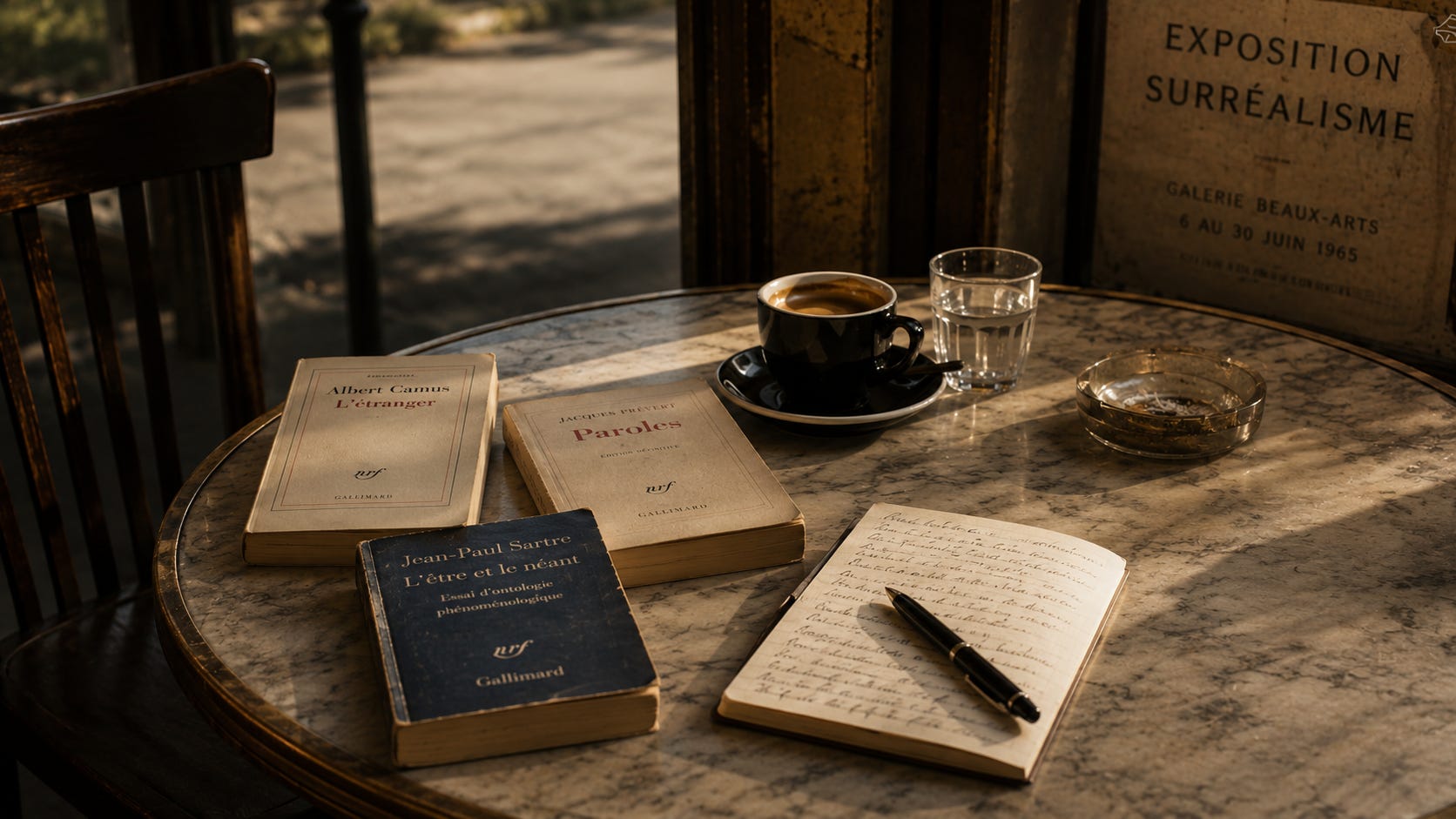
You probably thought this was going to be some refined exploration of French literary tradition. You gave me the benefit of the doubt and came on in anyway, so let’s be honest with each other about what this is. Three novels that explain France? A country that has been explaining itself to itself since Voltaire, that revels, frankly, in the argument for its own sake. The premise is absurd, and I know it’s absurd. I am going to make the case anyway. So…we begin, of course, with an American poet.
Robert Frost, who was born in San Francisco and became, like me, an adopted New Englander, wrote a poem about standing at a fork in the woods, sorrowful that he could not travel both paths. The poem is almost universally read as a celebration of the road less travelled, the braver choice, the rugged individual striking out from the herd. Frost was laughing. The two roads were, as he wrote plainly, worn about the same. The choice was arbitrary, and he knew it. What he was really writing about was the story we tell ourselves afterward, looking back from some imagined future, claiming with a satisfied sigh that it made all the difference. Milan Kundera, in The Unbearable Lightness of Being, suggests that human beings unconsciously compose their lives according to the laws of beauty, turning coincidence and distress into patterns that appear meaningful in retrospect.
I am recommending three French novels as the road less travelled. I am aware of the irony. I am telling the story anyway, because the story, as it turns out, is the point.
But first: the pork pie. The proper sausage roll. The bacon that was not fried to a crisp, the Sunday roast that nobody here could quite replicate, the particular comfort of meat and two veg on a grey afternoon. I have been there, standing in a Shaw’s supermarket in my current hometown of Montpelier, Vermont, willing pork pies into existence through sheer force of longing. I’ve felt the ‘shame’ of being told, “we don’t cook limp bacon” when asking a waiter if my bacon cannot be cooked to a crisp. It’s not one of my finer moments, and yet, I’m not sure I would trade it. The familiar has a strong magnetic field, and I have felt it pull harder with each move, each new country, each fresh unpacking of an accumulated life. The seductive desire to give in and let the familiar catch you is the most human response to displacement there is. The Brit who spends two weeks in the south of Spain drinking warm ale and eating a Full English every morning is not a fool. He is managing the displacement with the tools he already has. Barthes noticed the same instinct in his own countrymen: the French abroad reach for steak-frites as a patriotic act, a way of temporarily repossessing the culture they have left behind.
The question is not whether you will feel it. You will. The question is whether you let it become the whole story.
Which is where the novels come in. Not as a map or guidebook. And certainly not as an approved reading list for the relocating expatriate. But as Mirrors. Kundera gives me the theory: that we compose our lives backward, arranging accident into beauty. But Flaubert, Camus, and Proust give me something more practical. Each shows a version of the self that France will, sooner or later, test. One, in particular, evoked some wonderful long-held memories for me, as you will discover.
I have read Madame Bovary a couple of times, and what struck me each time is that Emma is not destroyed by provincial France, however much she imagines herself trapped by it. She is destroyed by a longing for a life she has never actually lived, a phantom existence so vivid to her that nothing Yonville can offer stands a chance against it. She fills her imagination with romance, sophistication, intensity, Parisian elegance, and grand passion. She receives them first as literature, fantasy, and atmosphere, just as we look forward to leaving, and assemble our pre-departure ‘mood-board’. The picture-postcard version of a life we plan to inhabit. The reality of France; of any new home, inevitably, arrives slower.
Emma’s tragedy is not that she chose wrongly. It is that she could not stop mourning the imagined lives that reality could never fully equal. Most of us do this in one form or another. We arrange accidents into narratives. We construct parallel versions of ourselves who made the other decision, took the other train, stayed in the other marriage, moved to the other city.
As Kundera implies throughout The Unbearable Lightness of Being, living only one life can feel strangely insufficient, as though we are forever haunted by unlived alternatives. France, perhaps more than anywhere else, seems culturally comfortable with examining this tension openly. Its novels, films, cafés, philosophy and conversations return endlessly to the same quiet question: not merely “How should we live?” but “How do we live knowing life will never entirely resemble the story we imagined for it?”
Most of us arriving somewhere new carry a version of this. The imagined life in Lyon, in Bordeaux, in some particular arrondissement of Paris, full of possibility in a way the lived version will not quite match. The novel does not fix this. It shows you the shape of the trap before you walk into it, and oddly enough, there is something liberating in recognising that.
Every culture has its unwritten rules about how feeling should be expressed in public. France simply enforces its version with more precision than most. When to grieve visibly, when to participate, when to signal that you understand the room: these are not minor social niceties. Camus knew this. Meursault, the protagonist of L’Étranger, does not commit his greatest offence in the courtroom. He commits it by failing, consistently, to perform the emotional responses his society expects of him. The verdict is really about that.
If Camus reveals the social codes of belonging, Proust exposes the private ones. Taste, scent, ritual and place attach themselves to memory in ways that are almost impossible to explain rationally. In In Search of Lost Time there’s a scene in which the narrator tastes a small madeleine dipped in tea, and the taste does not merely satisfy hunger. It unlocks memory, emotion, childhood, place, family, architecture, and an entire vanished world.
As I read it, I am transported back to eleven-year-old Steve and his first encounter with France in the small community of Port-Sainte-Marie, and the still vivid memory of the extended family dinner given in my honour as the exchange student d’Angleterre. I can still remember the scenes of preparation as the dining room was set for fifteen guests and the afternoon light that poured through the French doors, draped from ceiling to floor with lace curtains. I can still smell the garlic-infused aroma of a chicken spit-roasting in front of an open-hearth fire in the kitchen.
As a young boy from England, I was totally unprepared for the formality of a traditional French dinner. I did not, of course, consume a glass of Vermouth, though watered-down wine was introduced at some point. I eagerly consumed the nuts and small savoury bites handed around during the apéritif, all without knowing quite what else would be put in front of me: the soup, the main course of roasted chicken and my first taste of garlic, the vegetables, and then the salad. The salad after the main course was a surprise, but it arrived right on cue to refresh the palate before the cheese, with freshly baked bread. So many cheeses…No crackers? All topped off with the most extraordinary crème caramel I had ever tasted. I believe that meal lasted five hours, though that may be my failing memory, or the extended sense of time of an eleven-year-old. Nonetheless, as you can no doubt hear from the retelling, that evening had a profound impact: fifty-five years later, it remains the most memorable meal of my life.
All this is to say: the French take their food and wine seriously. While that particular meal was staged as a special occasion and times have moved on, there is still some truth in the observation that where we in the UK or the USA often eat to live, the French live to eat.
As a newcomer to France who may come to be invited to such gatherings for special occasions, being prepared for a version of this may serve you well. Know also that it could feel every bit as long for you as it did for me, as you attempt to follow conversations and assemble your hastily translated sentences only to realise the conversation has already moved on. You may be exhausted by the end of the evening. But as the years pass and you become accustomed to such gatherings, it is my hope that many years from that first experience you will remember it just as vividly.
There is a version of expat life that involves retreating almost entirely into the familiar: the enclave of people who share your references, laugh at the same things, and require nothing of you in the way of cultural adaptation. I expect to want some of that, and to use it. The question is one of proportion. Retreat into isolation is not neutrality. It is a position, and it has consequences. The expat enclave becomes a problem only when it substitutes for the harder, slower, more rewarding work of belonging somewhere that does not yet recognise your face.
Here, then, is what I think these novels are actually for. Not maps. Not primers. Not cultural homework assigned by some imagined Taste Tribunal. They are, in Kundera’s phrase, a chance to inhabit experimental selves: to live briefly inside the lives we did not choose, to test the roads we could not travel. Reading French fiction before you arrive in France is the closest available approximation of living a life you have not yet chosen.
The polite thing, before you walk in, is to have at least listened a little.
These are the costs of choosing a life that crosses borders, and just getting on with it… Non, je ne regrette rien.
These essays arrive fortnightly. If any of this sounds like something you want to read, or something you are living through yourself, I am glad you found your way here.
Steve Scrivens
Montpelier, Vermont
If this essay resonated with you, you can support Where We Start From with a one-off coffee.