
The Gate Keeps Moving
On technology, art, and the artist’s search for an ethical path through disruption

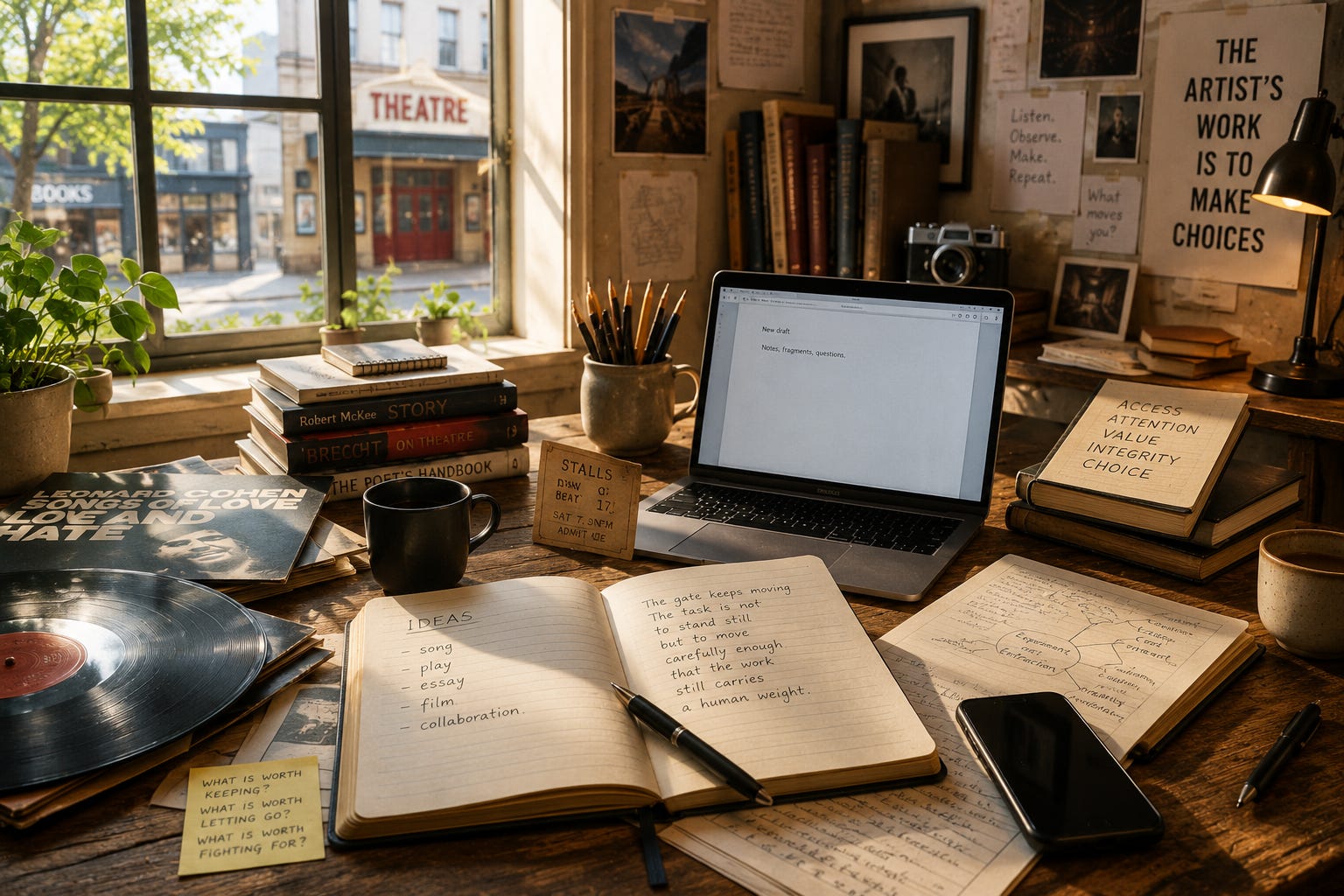
This is the first in a new occasional strand I am calling Dispatches: pieces that sit alongside my main Where We Start From sequence when a subject presses too directly on the wider culture, or on the life of artists and writers, to wait its turn.
This first dispatch looks at artists, technology, gatekeepers, and the search for an ethical path through disruption. A second will follow, looking more directly at artists already trying to work with new tools in serious and thoughtful ways.
This will set you free.
There is a promise that arrives with almost every new technology It may not use those exact words, but the promise is usually there. The old barriers will fall. The old gatekeepers will finally lose their power.
The artist will not have to wait for permission. The musician doesn’t need the record label. The writer no longer needs the publisher. The filmmaker opens their movie with no Studio in sight. The theatre-maker will not need the institution. The audience will be reachable directly, immediately, globally. Right?
It would be foolish to deny it completely because there’s some truth in it. It’s also true that many artists have been held back by old systems that were narrow, expensive, slow, complacent, class-bound, risk-averse, or simply closed to anyone without the right introduction. Any tool that loosens those systems is worth paying attention to. Any platform that lets a writer find readers, a musician find listeners, or a performer find an audience without first passing through a guarded door has already done something worth taking seriously.
I’m not convinced however, that the gate ever disappears. The sign above it may simply change its name. The editor becomes an algorithm. Yesterday’s record executive becomes today’s playlist. The bookseller becomes a ranking system, and the critic becomes today’s metric.
The artist is told they have been liberated, and in some ways they have. However, they then discover that the new freedom comes with a new set of passwords with new platforms to learn. How do we feed the algorithm? What the heck is metadata? How can the title capture attention? We’re told to shorten the work. Keep people watching. Keep people listening. Keep people clicking. Keep people subscribing. We must be authentic, and also consistent. Originality is key yet we must be ‘deep’ but not slow. Be our true self, but preferably in a way that can be recommended to strangers before they lose interest.
In the middle of all this stands an artist, trying to keep pace. That is the person I’m interested in.
I don’t much care for the technology evangelist nor the professional scold. The person who declares each new tool to be either salvation or sin before anyone has had time to understand what it does to the work. I am interested in the working artist who has to make choices before the argument is even settled.
Most artists are not living in theory. They are trying to write, paint, compose, rehearse, record, publish, tour, teach, invoice, sell, edit, apply, promote, and begin again. They are trying to make something that has value on their own terms while the terms of value keep changing. This is not new. But it feels newly urgent.
The Question is older than AI
The Music Industry has already been through several versions of this disturbance. Napster made recorded music feel detachable from the object that once carried it. Downloads unbundled the album. Streaming made almost everything available almost everywhere, which is a miracle until one noticed what this miracle did to attention spans.
For listeners, the bargain was irresistible. More music. Less cost. Less waiting. Less friction. But for artists, the bargain was more complicated.
A musician could release work without waiting for a record deal. That mattered, and it still does. No serious account of the last twenty-five years should pretend the old industry was a paradise of fairness. The old gatekeepers excluded plenty of people who deserved to be heard. The artist’s work was now more visible but that’s not the same as being valued.
The catalogue became effectively infinite. The ‘45’ gained power. The album weakened as a shared cultural form. Cover art, once held in the hand, studied, lived with, and argued over, became a thumbnail. One might also wonder what happened to album cover artists commissioned to produce iconic album covers? Hi-fi, once a common aspiration for those who loved music and could afford even modest equipment, became a niche enthusiasm. Convenience won, as it usually does. The song travelled everywhere, but it also became easier to skip, easier to forget, easier to treat as atmosphere. Who, these days entertains the idea of listening to ‘both sides’ of an album? Some generations won’t even understand that sentence because it’s no longer part of the listening experience.
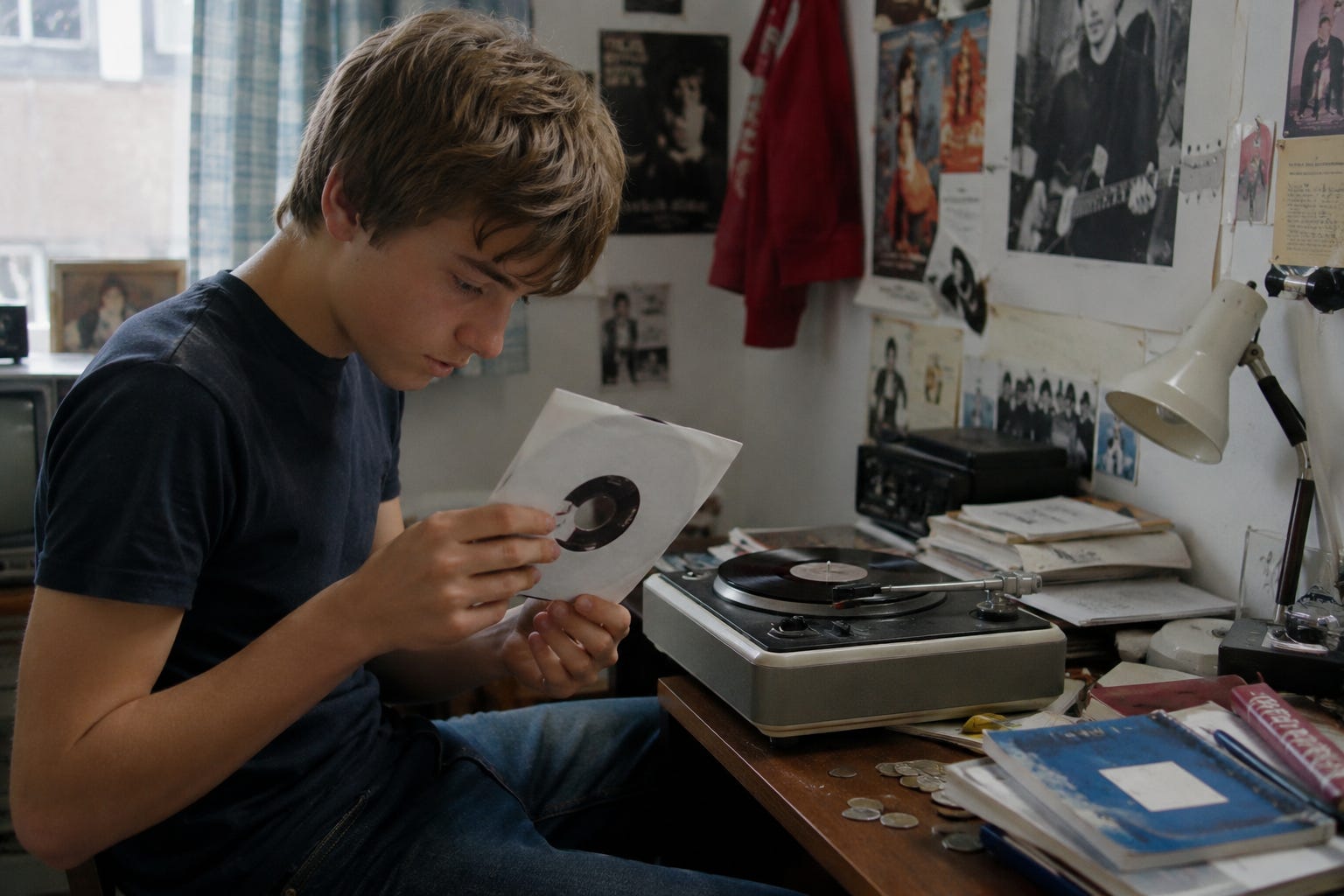
It wasn’t all bad. As artists and consumers got used to the new world, the live performance became, for some, the place where meaning and money returned. The room mattered again. The body of work mattered. The audience was no longer purely a statistic but a gathering of people who had left their homes and paid to be present.
But not every artist can tour. Not every performer can withstand it. Not every audience is large enough. Not every kind of music sits equally well in that economy. And the artist at the lower end of the pecking order remains familiar with the old problem in a new costume: everyone can hear you, in theory, but very few may actually listen.
Books have lived through their own version of the same story.
Amazon and digital publishing opened doors that traditional publishing had kept closed. A writer no longer has to wait for an agent, a publisher, a sales meeting, a bookstore buyer, or a review column. Self-publishing stopped being only a last resort and became, for some, a route to genuine readership. That is real freedom too, isn’t it?
The answer is nuanced. The market became accessible and that in turn created a crowded marketplace where the gatekeepers did not disappear so much as change clothes.
Rankings, reviews, metadata, recommendation engines, category placement, advertising spend, price expectations, reader impatience, online visibility. These became part of the new storm for writers to weather. The book could be published; Yes…but would it be found? Would it be read? Would it be paid for? Would the writer survive long enough to write the next one?
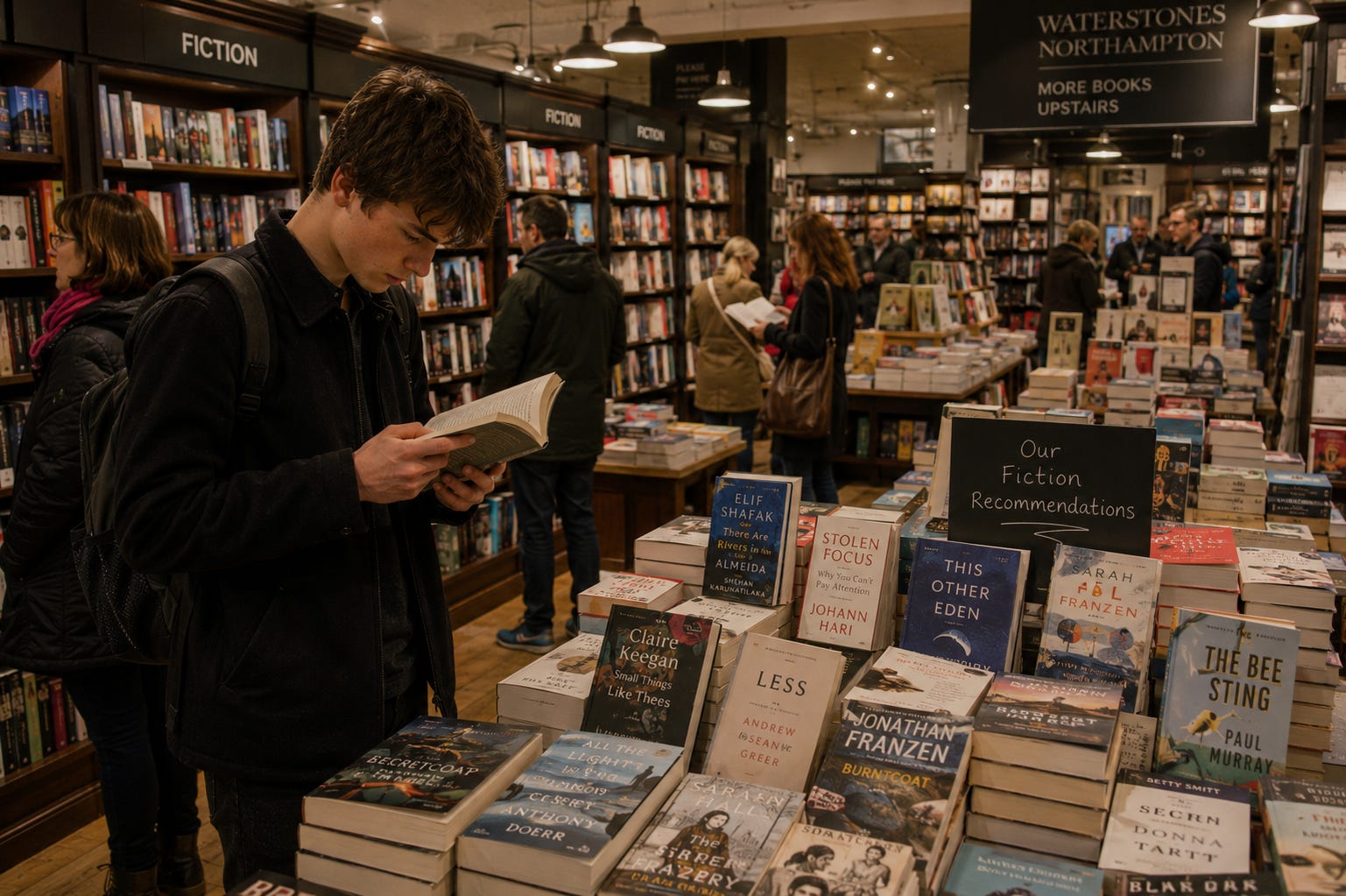
Meanwhile, the physical book did not die. If anything, for some readers it became more precious because it was no longer necessary. Paper, cover, weight, shelf, margin, the small ceremony of turning a page. A real book became not only a delivery system for words but a kind of resistance to the dissolving screen.
The Pattern Keeps Repeating.
A new technology removes friction. People rejoice. Then, after a while, some of them begin to miss the friction.
Vinyl returns. Bookshops matter. Film cameras reappear. Notebooks sell. Long-form essays survive inside the same culture that keeps declaring attention dead. Younger generations, born into the digital abundance that older generations once treated as liberation, begin looking back toward analogue objects with a hunger that is not entirely nostalgic.
Perhaps some of it is fashion. Most things are, at first. But perhaps fashion occasionally reveals a need before we know how to name it.
The need may be for ritual. For texture. For limitation. For forms of attention that cannot be endlessly refreshed, swiped, skipped, or optimised. A record ‘side’ imposes a duration. A theatre performance asks you to sit in the dark with other people. A printed book does not notify you of anything. These are not necessarily inconveniences but they are part of the experience.
Theatre knows this perhaps better than any art form, though it often pretends otherwise while trying to sell enough tickets to keep the lights on.
Theatre has had its own negotiations with attention and economics. The long multi-act play with intervals now competes with shorter, sharper forms that promise impact without demanding quite so much stamina from the audience. Sometimes that is artistically right. Some plays should be ninety minutes without an interval. Some should be shorter still. Length is not virtue.
An interval is not merely a pause in the action. It is a social ritual. It is a conversation in the Circle bar over the second glass of wine. It is the programme. It is also, in many cases, part of the economic bloodstream of the building. Ticket sales alone rarely tell the whole story of how theatres survive. Concession and alcohol sales are not incidental to the institution, however much the purist might prefer to talk only about the art.
So, when we shorten, streamline, intensify, compress, and remove friction, we may gain focus. We may also lose something that helped the whole ecology survive. This is the reality and difficulty for the regional Theatre.
Not all friction is useful. Some of it is waste. Some of it is snobbery. Some of it is gatekeeping dressed as standards. Some of it deserves to be destroyed.
AI’s Forceful Entry into the Arts World.
AI is not the first disruption. It is not the first tool to promise access, speed, scale, independence, or a way around the old guards. But it does reach further upstream than many previous disruptions. It does not only change distribution, sales, discovery, or audience behaviour. It has the potential to reach into the making itself.
It can draft the paragraph. Generate the image. Compose the track. Imitate the voice. Suggest the lyric. Mimic the style. Build the demo. Produce the mood board. Summarise the archive. Translate the text. Analyse the audience. Optimise the title.
The tool does not only ask artists to change how they publish or promote. It asks them to reconsider where the work begins and where authorship lives. That is why the argument around it is so heated and I understand why that frightens people.
Artists have already seen too much of their labour undervalued, copied, scraped, compressed, platformed, demonetised, repackaged and sold back to them as opportunity. Caution is not cowardice. Anger is not always reactionary. If a painter sees a machine produce images that resemble the work of thousands of unpaid artists, the painter is not being precious by asking who was used, who consented, and who got paid.
The same is true in music. Tools such as Suno and others may be astonishing in what they can produce, but the legal and ethical questions around training data, voice, style, ownership and compensation are still unsettled. There are court cases, licensing deals, denials, claims, counterclaims, and plenty of moral fog. To pretend none of that matters would be naïve. To call every concern a fear of the future is a bully’s argument.
I am also wary of the opposite certainty. The desire to declare the boundary settled before artists have even had time to understand what they are touching. The pleasure some people take in denunciation. The speed with which a difficult question becomes a purity test.
Art has never advanced by staying neatly inside inherited boundaries.
Artists throughout history have borrowed, trespassed, imitated, distorted, transformed, and reinvented. They have violated taste, offended propriety and fallen foul of censors. Artistic failure in public is the curse and the saviour of their existence, and sometimes in the process they discover their ethics by reaching an edge and realising that it should not be crossed. Do not misunderstand me, this is not a licence to exploit other artists. It is a reminder that discovery rarely begins with perfect moral paperwork. We need space to experiment and ask what responsibility looks like, and we must hold these two strands together, however inconvenient that may be.
Perhaps the most useful distinction then is between experiment and extraction.
Experiment says: I am testing a tool. I am trying to understand what it reveals. I am not hiding the questions. I am not pretending the machine’s work is simply mine. I am not exploiting another artist’s recognisable voice, likeness, labour or style without concern for consent. I am prepared to change course.
Extraction says: I will use whatever the machine gives me. I do not care what it was trained on. I do not care who is displaced, unpaid, or imitated. I will claim the result because the platform allowed me to generate it. I will call criticism nostalgia.
That distinction will not solve every argument. But it gives the artist somewhere to stand while the ground is moving. Copyright law is the temporary arbiter in such questions, but new technology is a constant thorn and the law develops slowly.
The Artist remains where the artist has always been
Between old gatekeepers and new ones. Between access and exploitation. Between purity and curiosity. Between the need to earn and the need not to cheapen the work. Between the fear of being left behind and the fear of becoming too quickly fluent in a language that does not quite belong to them.
This is where the older analogue examples still matter.
Bob Dylan and Leonard Cohen were not important because they possessed conventionally beautiful voices. They remind us, in different ways, that a song is not merely a polished object. It is a voice carrying consequence.
Dylan did not sing like a man asking permission from a conservatoire. His voice could accuse, mock, hurry, prophesy, joke, wound, and refuse comfort. Cohen, especially in later years, often seemed to move below singing into confession, prayer, mutter, seduction, and gravelled blessing. Neither voice was neutral. Neither was merely a delivery system.
When Dylan asked, “How does it feel?” the force of the question did not depend on vocal beauty. It depended on pressure. When Cohen wrote of “the crack in everything,” the line carried the dignity of damage, not the sheen of repair.
Jacques Brel belongs in this company for theatre people because he often seemed less to perform a song than to enter it like a room where something terrible had to be said. Just watch his performance of ‘Amsterdam’ and the way he exits the song.
Nina Simone could make a song feel judged and transformed in the act of singing it. Joni Mitchell in a profile interview with the New York Times (03/17/91) told us that confession without form is not enough; feeling still needs architecture.
These artists remind us that imperfection can be part of truth. However, sometimes ‘the grain of the voice’, to borrow Roland Barthes’s useful phrase, carries the body inside the sound taking it beyond mere timbre or expression
A machine may produce a voice that sounds aged, weary, intimate, wounded, joyful, erotic, furious, or devout. It may reproduce the surface of the ‘grain of the voice’. It may even move us but does it ‘feel it’? Does it care if I feel it? Theatre has always known that artificial things can produce real feeling. A staged death can make us cry. A painted sky can make us feel distance. But the question remains; Is the crack in the voice evidence of experience, or an effect selected from a menu?
That is not a small question. It is not a technophobic question either. It is an artistic one.
This publication, too, sits inside that tension. Substack offers writers a direct relationship with readers. That is genuinely valuable. It gives space to work at essay length, to build trust, to publish without waiting for a newspaper editor or magazine slot. But it also brings its own pressures: cadence, open rates, subscriber counts, pledges, titles, restacks, visibility, and the temptation to let the platform’s signals become the measure of the work.
My own main sequence of essays continues at its fortnightly pace. I have my plan for my series of essays exploring my personal journey, but occasionally topics such as this inspire me to explore my thoughts and ask for your opinions. Not every thought belongs inside a neat canon. Sometimes the culture intrudes, and one has to make a place for it.
I am trying to make more of my living from the work that has always mattered most to me: writing, theatre, producing, perhaps eventually projects that cross from page to voice to music. That is not a clean artistic fantasy. It is practical, uncertain, and occasionally embarrassing. Reinvention becomes less romantic as one gets older and takes on practical and time-bound qualities instead. It needs invoices, calendars, files, rights, collaborators, readers, and more stamina than the word suggests.
Technology may help.
It may help me organise an archive, retrieve old fragments, test an idea, prepare a draft, compare structures, translate a phrase, or understand where a line is not yet working. It may help resurface work stored long ago and badly filed or categorised. Used carefully, it may remove forms of friction that are merely clerical, expensive, or obstructive. Or just simply be an aid to a failing memory or recall system.
If it removes the wrong friction, it damages the work.
That is why the conversation around AI and art needs more room than it is often given. Artists should be allowed to be curious without being instantly condemned. They should also be expected to think seriously about consent, credit, money, labour, and the people whose work made the tools possible.
Grace is not the same as permission to exploit. Suspicion is not the same as wisdom. We need something slower than panic and firmer than innocence.
Perhaps each artist will have to find a working ethic before the culture agrees on a settled one. That is uncomfortable, but it may be unavoidable. A painter’s boundary may not be the same as that of a musician and so too, the playwright and the photographer. A disabled artist’s use of AI may transform a hitherto inaccessible idea and help them bring it to life.
It is tempting to be absolute and pure as we apply these tests to what now confronts us all, but I am suggesting that such certainty, so soon may not be in our long-term interests.
What we can ask, perhaps, is whether the work remains accountable.
Who chose? Who consented? Who was paid? Who was imitated? Who was hidden? Who was helped? Who was replaced? Where did the risk remain? Where did the artist stay present?
Those questions will not make the path simple. But they may keep it honest.
I’m afraid the gate will probably keep moving and new keepers may continue to stand in our way as they always have. As artists we will keep standing somewhere in the middle, irritated, tempted, wary, hopeful, compromised, curious, trying not to be made foolish by either fear or enthusiasm.
The task is not to stand still and call it integrity. Nor is it to rush forward and call it courage.
The task is to move carefully enough that the work still carries a human weight.
The tool may help.
The platform may help.
The audience may help.
The old forms may still help too: the book in the hand, the record side, the theatre interval, the imperfect voice, the lines that resist being made easy.
Somewhere among all of that, an artist has to choose.
And the choice still matters.
These essays arrive fortnightly. If any of this sounds like something you want to read, or something you are living through yourself, then I am glad you found your way here.
Steve Scrivens
Montpelier, Vermont
Steve, this gave me so much to sit with. The idea that the gate never disappears, it just changes its name.
What stayed with me most was the question of voice. Writers have always had editors, readers, hands that shaped the work before it reached anyone.
The help was never the problem.
The danger was always the same: letting another hand smooth away the very thing that made the voice yours — the roughness, the accent, the crack Cohen sang about. A good editor protects that; a careless one polishes it out. I think that's the real test, whatever the tool: does the work still carry your fingerprints, or someone else's sheen?
The voice has to survive the help. That's the line I keep walking.