

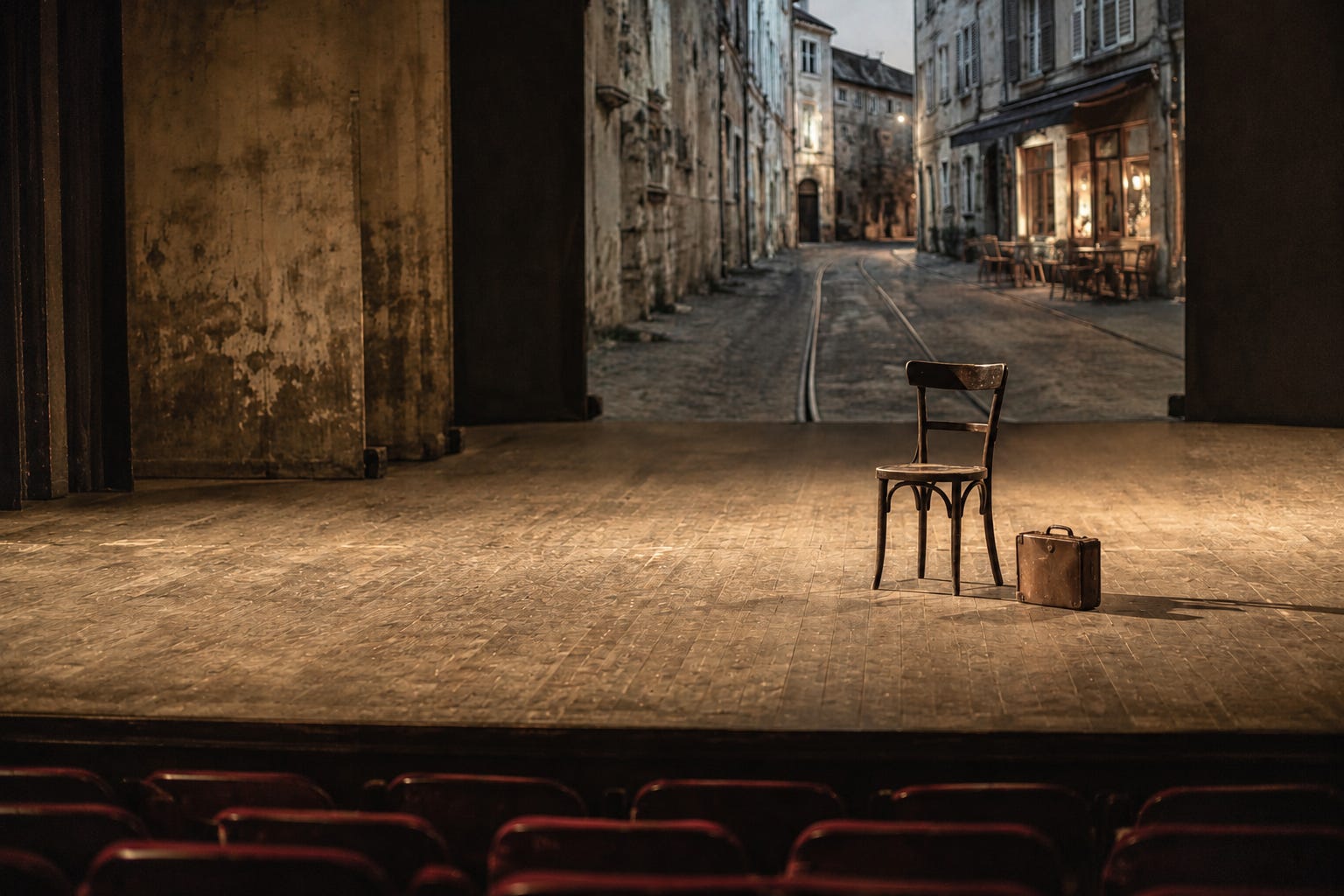
They say talking to yourself is the first sign of madness, and answering back is the second. I have always thought that a little harsh. In the theatre, we call it rehearsal.
This essay, indeed, this whole series, was meant to be about France: the plans, the practicalities, the imagined geography of a future life. But somewhere in the talking-through with friends, or with myself, often at 2am after a delayed airport transfer ride for one of my customers, the shape of it changed.
I realised I was not simply writing about moving country. I was writing about a life in motion: the way one decision alters the scene, the lighting, the cast, and eventually the part we thought we were playing.
The Rehearsal Room
When I began this series, I thought I understood its shape. I had arranged the essays into movements, partly as a nod to my early musical training and partly because the word itself seemed right. A movement is not simply a section. It has its own character, pace, emotional argument and resolution. It belongs to the larger work, but it must also breathe on its own.
That seemed a useful way to organise a series about leaving America after nearly fifteen years and preparing for a move to France. There would be the reckoning, the preparation, the threshold, the crossing, the first impressions, and whatever came after. It had structure. It had timing. It had, if I am honest, the comforting quality of a plan.
And I like a plan.
This is not a confession of rigidity, or at least I hope it’s not. In my experience, plans are less about control than orientation. They give me something to push against. I often make elaborate structures before I act, knowing perfectly well that life will interfere with them. The structure is not the destination; it’s the rehearsal room.
People who have worked in theatre understand this instinct. You begin with a script, a schedule, a design, a budget, and a set of assumptions about what the production is going to become. Then actors enter the room. The chair is in the wrong place. A line you thought would land does nothing. A silence opens where you had not expected one. The scene starts to tell you what it is really about.
That, I think, is what has happened with this essay.
At first, the title seemed straightforward enough: The Theatre Producer’s Eye: Reading a City as a Stage. I imagined writing about Montpellier, or France more generally, as a place to be read through theatrical instinct: the light, the streets, the rhythm, the public squares, the cafés, the markets, the tramline, the movement of people through space. I still think that is there. It is a good subject. It may even be the visible subject. But the deeper subject has shifted.
France has become less the destination than the setting. The real question is not simply, “Where am I going?” It is, “What kind of life becomes possible on that stage?”
Sightlines
I have been drawn to France for many reasons, some practical, some cultural, some emotional. Language helps. So does proximity to my children, Britain, and the wider European world that I still feel connected to. There is food, of course, and history, and architecture, and the possibility of living again in a place where public life happens at human scale. But none of those things, taken alone, quite explains the pull.
The more I have thought about it, the more I have come to believe that I am not looking merely for a country. I am looking for a different set of sightlines.
In a theatre, sightlines matter. They determine what can be seen, what remains hidden, and how the audience understands the story unfolding before them. A badly placed pillar can obscure a revelation, and make you wish you’d bought better seats. A well-lit doorway can prepare us for an entrance before anyone appears. Space teaches us how to pay attention.
Cities do something similar. Some places widen our field of vision. Others narrow it. Some encourage us to move privately from one sealed interior to another: house, car, workplace, supermarket, car, house. Others place us at eye level with life itself: faces, windows, menus, arguments, market stalls, dogs, buses, church bells, bicycles, cigarette smoke, stone, rain, conversation, impatience, flirtation, habit. The ordinary theatre of being alive.
I do not want to caricature America here. Vermont has its own visual poetry, and I have been grateful for so much of what it has given me: space, reinvention, work, landscape, new long-term friendships, a degree of independence, and a kind of practical self-reliance I might not have learned elsewhere. But there comes a time when a setting that once supported a life may no longer support the next version of it. I don’t see this as failure, and as my recently departed mother would often say: “It is what it is.”
A theatre producer learns to ask certain questions. What is the rhythm of this room? Who is holding the attention? Where are the entrances and exits? What is visible? What is merely decorative? What does the space allow, and what does it prevent? Where is the energy? Where is the deadness? What story can be told here?
These are not always conscious questions until we start answering them in our minds, and the older I get, the more I realise that I have been asking versions of those questions for most of my life.
The Wrong Production
Music and theatre were there early. I played clarinet from childhood into early adulthood, with enough seriousness to perform in orchestral settings and at National Youth Orchestra level. I sang in choirs. I performed in school productions, stage-managed, debated, organised. Then, for a long interlude, I entered financial services, a world that might seem, at first glance, far removed from theatre, except that it too required performance. I designed presentations, explained investment ideas, spoke to rooms, translated complexity into something people could sit with and understand as they too faced a new beginning; a new stage.
Later came music festivals, theatre festivals, promoting, programming, and the long, persistent pull of producing. Even the detour that went spectacularly wrong, the nightclub I bought when I was really looking for a jazz venue, taught me something about audiences, atmosphere, risk, and the danger of mistaking one production for another.
I had imagined a certain kind of room: mature, musical, smoky perhaps, though by then smoking was already vanishing from public interiors; a place for jazz, food, conversation, midlife reinvention. What I inherited instead was drum ‘n’ bass, trance, RnB, late nights, drugs, younger crowds, and a harder, more chaotic energy than the one I had set out to create.
In theatrical terms, I had bought the wrong production.
It was a rash move, and it ended badly. I lost my home and a long-term relationship. There followed many dead-end jobs, moments close to despair, and a period when I was not far from homelessness. I do not write all this to dramatise the fall. I am generally wary of turning private difficulty into public theatre. But there are some facts that matter because they explain the later shape of a life.
What interests me now is not the collapse itself, but the instinct that followed.
When I needed stability, dignity, and a way back into the world, I found myself drawn toward theatre. A job at the Royal & Derngate in Northampton, England began at the box office, on a fraction of the salary I had earned in financial services. Soon after, by one of those strange reversals that only looks neat in retrospect, I moved into the programming department, having previously been the second choice for the role and latterly became the Programming Manager curating seasons of work across five performance spaces.
I went from a fifth-floor two-room apartment, no car, no credit cards, and the remains of a bruised life, into a world where the questions that had always interested me suddenly had professional names. What belongs on a stage? Who is the audience? How does one production sit beside another? What does a season say about a theatre, a town, a culture, a moment? How do people gather around stories?
I did not want to become a theatre producer because I had always followed a clean, direct path toward theatre. I came to it after detours, collapses, improvisations, false starts, and recoveries. Perhaps that is why the phrase “theatre producer’s eye” matters to me.
It is not just a profession. It is a way of seeing, assembled over time. The theatre merely gave it a name.
Recast
This is where Shakespeare becomes unavoidable. “All the world’s a stage,” says Jaques in As You Like It, “And all the men and women merely players.” It is one of those lines so famous that it risks becoming ornamental. We quote it because it sounds grand and melancholy, a little wise, a little resigned. But the longer I sit with it, the less decorative it feels.
Shakespeare’s speech is about the seven ages of man: infant, schoolboy, lover, soldier, justice, old age, and the final shrinking of the body toward dependency. At first glance, it can sound almost cruel. We enter, we perform, we decline, we exit. But there is another way to read it.
We are not one fixed self, moving through a stable world. We are repeatedly recast.
Son. Brother. Schoolboy. Musician. Debater. Advisor. Presenter. Divorcee. Nightclub owner. Box office clerk. Programmer. Producer. Immigrant. Taxi driver. Writer. Late-life beginner. Expatriate. Each role arrives with costume, language, expectation, status, and timing. Some roles we audition for. Some are handed to us. Some we resist long after the scene has changed.
The danger is continuing to play a part after the production has moved on.
Montaigne understood this better than almost anyone. He did not write a theory of reinvention; he observed himself in the act of changing. “I do not portray being,” he wrote, “I portray passing.” That sentence feels almost built for later life. It rejects the idea that the self is a finished monument. We are not statues. We are weather. We are movement. We are revision.
If Shakespeare gives us the stage, Montaigne gives us the changing actor.
The twenty-year-old self who played music seriously then gave up, the man in financial services, the rash nightclub owner, the exhausted survivor, the theatre programmer, the person who crossed the Atlantic to Vermont, and the person now contemplating France are not simply the same actor in different costumes. The actor himself has altered. He has learned, lost, hardened, softened, defended himself, opened again, and misunderstood himself more than once.
That may be the part of ageing we discuss too rarely. We speak of ageing as accumulation: more experience, more memory, more knowledge, more scars. But ageing is also subtraction. Certain ambitions fall away. Certain illusions become too heavy to carry. Some friendships disappear, some identities no longer fit, and some futures quietly close. The question is not only what remains, but what can still begin.
The Empty Space
This is where the great producer and director Peter Brook becomes useful to me, though I do not want to drag the reader into theatre theory. Brook’s great insight in The Empty Space begins with the simplest proposition: an empty space can become a stage when someone crosses it and someone else watches. Theatre does not begin with scenery. It begins with attention.
That idea has influenced me because it changes how one looks at places. A café is not merely a café. A taxi rank is not merely a taxi rank. A railway platform, a market square, a rehearsal room, a Vermont road in winter, a tram stop in Montpellier: all can become charged spaces if one pays attention to what is happening between people.
Perhaps that is why cities matter so much to me now. Not cities as postcards or lifestyle accessories, but cities as living arrangements for attention.
The kind of place I am seeking won’t be perfect. France will have bureaucracy, cost, loneliness, taxes, language frustrations, housing complications, and all the usual backstage machinery that beauty tends to conceal. A life in France will still involve forms, appointments, bank accounts, winter mornings, misunderstandings, and the ordinary disappointments of being human. I am not auditioning for someone else’s French fantasy. But I am asking whether a different setting might draw out a different attentiveness.
After years of work organised around usefulness, survival, transport, deadlines, clients, income, and practical necessity, I find myself increasingly interested not in luxury, but in texture: the difference between passing through a place and inhabiting it; between scenery and stage; between being surrounded by life and being arranged at a distance from it.
That may be why the practical relocation essay I had planned didn’t grip me and no longer felt sufficient.
There are many useful pieces to be written about visas, healthcare, renting, language, banking, cost of living, tax, residency, and the administrative choreography of moving from one country to another. I may write some of them. They matter. Paperwork can obstruct a life. Money can limit choice. Health can narrow the possible. Romantic essays do not survive contact with consulates.
But paperwork is rarely the deepest obstacle, and I am more drawn to issues of identity, which is where the deeper questions lie.
The Reckoning
Who am I when the work that defined me changes? Who am I when the country that hosted my most recent reinvention is no longer the place where I imagine staying? Who am I when the habits that helped me survive may not be the habits that help me live? Who am I if the next act requires less striving and more attention? What role am I still playing because I know the lines, and what role might I now need to learn?
This is why the first movement of this series is called The Reckoning. I am not sure I fully understood the title when I chose it. Sometimes titles know more than writers do. I thought the reckoning would be about departure: leaving America, making decisions, confronting practical realities, preparing the ground. But it has become something more interior.
A reckoning is not only an account of what has happened. It is an encounter with what is true, and the truth, at least for now, is that France is not the story. France is the device that allows me to examine the story.
That does not make France less important. Quite the opposite. In theatre, the setting matters enormously. Change the room and you change the behaviour. Change the light and you change the mood. Change the distance between people and you change the emotional temperature of the scene. A city can invite certain versions of us forward and leave others stranded in the wings.
I am interested in what France might invite forward.
Not a fantasy self. Not the old cliché of the expatriate reborn through cheese, wine, shutters and late afternoon sunlight. Those pleasures exist, and I do not intend to be nobly indifferent to them. But they are not enough by themselves. The more serious possibility is that France may offer a stage on which the next version of my life can be more truthfully performed: a life with more language, more looking, more writing, more theatre, more proximity to history, more acceptance of limits, and more willingness to revise.
That last word may matter most.
The Cue
Revision is often treated as correction, but in theatre it can be about discovery. A production discovers what it is by entering the room. A life may be no different. We think we are implementing a plan, but reality keeps rewriting the scene. Italy becomes France, as it did for me. A relocation essay becomes an essay about transition. A practical series becomes an inquiry into ageing, identity, memory, belonging, and the strange persistence of hope.
Montaigne would not be surprised. He would probably warn me that wherever I go, I take myself with me. That is true, and I have acknowledged this in earlier essays. France will not abolish my contradictions. It will not edit out my past, solve every practical problem, or hand me a more elegant identity at the border. But a change of country can still change the questions we ask of ourselves.
Will this be enough?
Perhaps.
The theatre producer’s eye is not only trained to notice what is on stage. It notices what is missing, what is misplaced, what is over-lit, what has gone dead, what has unexpected energy, what needs cutting, what deserves more space, and when an entrance or exit has arrived.
Maybe that is what I am doing now. Not escaping America. Not idealising France. Not retiring from life. Not pretending the next act is already written.
I am reading the stage.
And the more carefully I read it, the more I understand that the move itself is only part of the drama. The larger work is the life that has been rehearsing beneath it: the music, the failures, the recoveries, the theatres, the roads, the conversations, the plans revised and revised again.
All the world may indeed be a stage. But at this point in life, I am less interested in the grandness of the metaphor than in its practical wisdom. Every stage has limits. Every role has a duration. Every production teaches us something, even the ones that close badly. And every so often, if we are fortunate, we recognise that the scene has changed before the curtain falls.
That recognition is not an ending.
It is a cue.
These essays arrive fortnightly. If any of this sounds like something you want to read, or something you are living through yourself, I am glad you found your way here.
Steve Scrivens
Montpelier, Vermont
If you prefer, you can support Where We Start From with a one-off coffee.
Deeply insightful. I agree that revision is almost always about discovery. John Berger's in _Ways of Seeing_ you may have read?
Hope you find value on my site, as well. Will check in here whenever you comment.
Good luck on this move--the US right now though I still have hope is problematic -- and I know other artists who are leaving.
The depth and thoughtfulness of your essays remind me of my friend Jason Anthony's writing. You might want to check it out. https://jasonanthony.substack.com/. He's a gorgeous writer.